


The short version
- Remove the battery and carry it into the cabin. The wheelchair travels in the cargo hold. The battery never does.
- Tell your airline when you book. Give the airline your chair’s folded dimensions and the watt-hour rating printed on your battery.
- Arrive one hour earlier than usual.
- Check your chair as soon as it is returned, before you leave the gate area.
The three rules that matter
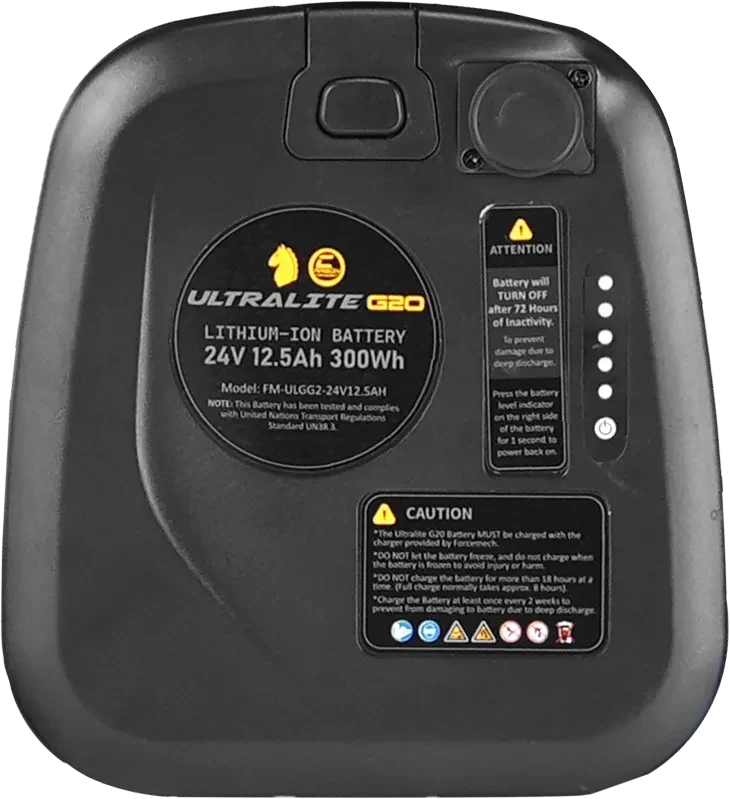
The FAA sets the battery limit. For a wheelchair whose lithium-ion battery is removed for travel, the battery may not exceed 300 watt-hours. It must go in the cabin as carry-on, with its terminals protected from short circuit, and you must tell the airline where it is. You may also bring one spare battery of up to 300Wh, or two spares of up to 160Wh each. Source: FAA PackSafe.
The DOT protects your right to fly. Under the Air Carrier Access Act, airlines must accept battery-powered wheelchairs that fit the aircraft and meet safety rules. Your wheelchair is carried free and does not count toward your baggage allowance. It must be returned to you as close to the aircraft door as possible, unless you ask to collect it at baggage claim. Source: U.S. Department of Transportation.
The TSA screens you and your chair together. You may remain seated in your wheelchair during screening. For help at the checkpoint, contact TSA Cares at 855-787-2227 at least 72 hours before your flight.
Airlines may set stricter rules than the FAA, and several have. That is why the airline table below matters.
Which Forcemech models can fly
| Model | Battery | Watt-hours | Air travel |
|---|---|---|---|
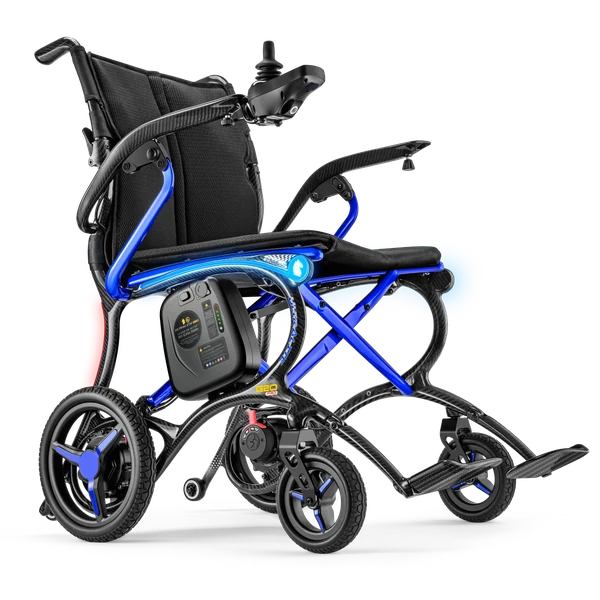 Ultralite G20 PRO | One removable ForceMax®, 24V / 12.5Ah | 300 Wh | Meets the FAA limit for a removable battery |
 Ultralite G20 | One removable ForceMax®, 24V / 12.5Ah | 300 Wh | Meets the FAA limit for a removable battery |
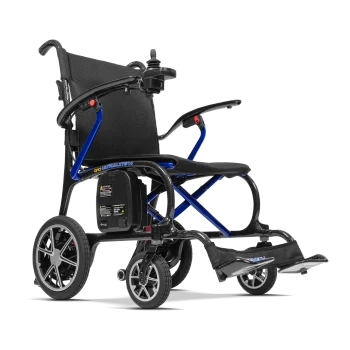 Ultralite G10 | One removable ForceMax®, 24V / 10Ah | 240 Wh | Within the FAA limit |
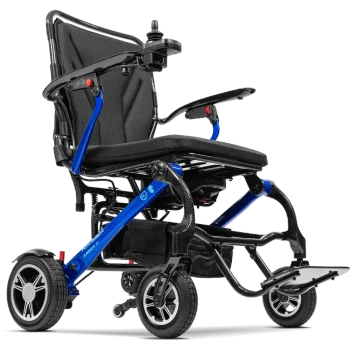 Carbon F1 | One removable battery, 24V / 10Ah | 240 Wh | Within the FAA limit |
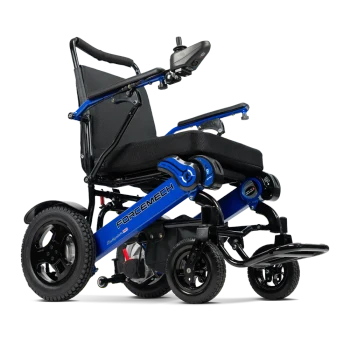 Navigator PRO | Two removable ForceMax®, 24V / 6.6Ah each | About 158 Wh each | Under 160Wh each; confirm the two-battery setup with your airline |
Why the G20 PRO travels so well
- A 300Wh ForceMax® battery, the largest removable battery the FAA permits on a mobility aid. You fly with the most range the rules allow.
- Removes in seconds, without tools, and weighs 2 lbs, so it sits easily under the seat in front of you.
- The watt-hour rating is printed on the battery label, which airline staff will ask to see.
- 100% carbon fiber, just 25 lbs without the battery. It folds to 29 × 10 × 28 inches. Confirm that it fits the aircraft operating each segment of your trip.
What each U.S. airline requires
The table compares published airline guidance and links to policy pages where available. Confirm battery limits and handling requirements with the airline operating your flight before booking.
| Airline | Lithium-ion battery rule | Before you fly | Contact |
|---|---|---|---|
 Delta Air Lines | Accepts lithium-ion wheelchairs. Removable batteries travel in the cabin with terminals protected. | Tell Delta at least 48 hours ahead. Print the Mobility Device Handling Form and attach it to your chair. | 404-209-3434 |
 United Airlines | Contact United to confirm its current rule for folding chairs with removable batteries. | Add your wheelchair to your reservation and call the Accessibility Desk before travel. | 800-228-2744 |
 American Airlines | From March 31, 2027: the battery must be removable, travel in the cabin, be rated 300Wh or less, and show its watt-hour rating on the manufacturer's label. Chairs with non-removable lithium-ion batteries will no longer be accepted. | Call Special Assistance before you travel. | 800-237-7976 |
 Alaska Airlines | The battery must be easily removable and carried in the cabin. Single-battery limit of 300Wh; with two batteries, 160Wh each. The label must be in English and show the rating. | Complete the Wheelchair Information form. Arrive 2 hours before departure. With a 300Wh battery, confirm acceptance with Alaska before you book. | 1-800-503-0101 |
 Southwest Airlines | The battery must be removed without tools and carried in the cabin. Single-battery limit of 300Wh; with two batteries, 160Wh each. It does not count toward your carry-on allowance. | Add your wheelchair when you manage your reservation. Bring the Wheelchair / Mobility Aid Information Form to the counter. | See southwest.com |
 JetBlue | A removed lithium-ion battery travels in the cabin with terminals protected and may not exceed 300Wh. | Add a Special Service Request to your booking and complete the wheelchair information form. | See jetblue.com |
 Spirit Airlines | Spirit has announced that it is winding down operations and all Spirit flights have been canceled. | If you held a reservation, check the airline’s notice for next steps. | See Spirit’s notice |
 Frontier Airlines | A removed battery travels in the cabin and may not exceed 300Wh. | Notify Frontier before travel and arrive as early as possible. | See flyfrontier.com |
 Allegiant Air | On a folding chair with an exposed battery, the battery must be removed and carried on. It may not exceed 300Wh. Battery details must be legible and in English. | Check your chair at the ticket counter or the gate. | See allegiantair.com |
Three things to know when reading this table:
- Rules are tightening in favor of removable batteries. Southwest now requires removal. American will from March 31, 2027. A chair with a removable 300Wh battery already meets both.
- Smaller regional aircraft need more notice. On aircraft with fewer than 60 seats, an airline may ask for 48 hours' notice for an electric wheelchair.
- Flying abroad? International airlines follow similar limits but set their own procedures. Confirm with each airline on your itinerary.
Your travel checklist
When you book
- Choose a nonstop flight where you can. Every connection is one more time your chair is loaded and unloaded.
- Tell the airline you are bringing your own folding electric wheelchair, and give them the details below.
- Request the help you want: an airport wheelchair, an aisle chair for boarding, and pre-boarding.
What to tell the airline about a G20 PROFolding electric wheelchair, 25 lbs without battery, 29 × 10 × 28 inches folded, one removable lithium-ion battery rated 300Wh.
Two to three days before
- Call the airline's accessibility desk to confirm your wheelchair is noted on the reservation. Write down the agent's name and the time.
- Print and complete the airline's wheelchair form. Attach one copy to the chair and keep one with you.
- Contact TSA Cares if you would like help at security.
- Inspect your battery. The case should be intact and the label easy to read.
What to pack

At the airport
- Arrive one hour earlier than you normally would.
- Go to the ticket counter first. Staff will inspect the chair and battery and give you a gate-check tag. Ask for your chair to be returned at the aircraft door.
- Stay in your own chair through security and all the way to the gate.
At the gate
- Switch the chair off, remove the battery, cover the terminals and place the battery in its pouch.
- Fold the chair and hand it to the gate staff with its tag attached.
- Board early with your battery, and tell a flight attendant where you have stowed it.
When you land
- Wait in your seat until your chair arrives at the aircraft door.
- Unfold it, refit the battery and drive a few feet. Check the frame, wheels and joystick.
- If anything is wrong, report it before you leave the airport.
If something goes wrong
| Situation | What to do |
|---|---|
| Staff say you cannot bring your chair or battery | Ask calmly for the Complaints Resolution Official, or CRO. Every airline must make one available, in person or by phone, at no cost. Show your battery label and specifications. |
| Your chair is damaged | Photograph it and file a claim at the airline's service desk before you leave the airport. Airlines must return your chair in the condition they received it and pay for damage that happens in their care. |
| Your chair does not arrive | Report it at the service desk and ask the CRO about a loaner chair while yours is located. |
| The airline does not resolve it | File a complaint with the U.S. Department of Transportation. |
Keep your purchase receipt. It is the simplest proof of your chair's value.
Common questions
- Can you take an electric wheelchair on a plane?
- Yes. U.S. airlines must carry battery-powered wheelchairs that fit the aircraft and meet safety rules, at no charge.
- What is the lithium battery limit for a wheelchair on a plane?
- For a battery that is removed from the wheelchair, the FAA limit is 300 watt-hours. The battery must travel in the cabin.
- Is the Forcemech G20 PRO allowed on airplanes?
- Its removable ForceMax® battery is rated 300Wh, which meets the FAA limit for a removable wheelchair battery. Airlines set their own procedures, so confirm with yours before you book.
- Does the battery go in checked baggage?
- No. A removed lithium-ion battery must be carried in the cabin, never checked.
- Do airlines charge for a wheelchair?
- No. A wheelchair is carried free and does not count toward your baggage allowance.
- Can I bring a spare battery?
- Yes. FAA rules allow one spare of up to 300Wh, or two spares of up to 160Wh each, in carry-on only.
- How early should I arrive?
- One hour earlier than the airline's normal check-in time. Alaska Airlines asks for 2 hours before departure.
We are here to help you travel
Planning a trip with your Forcemech? Our support team can send your battery specifications and UN 38.3 test documentation on request, ready to show your airline.
- Call1-877-90-FORCE (1-877-903-6723)Monday to Friday, 9 AM to 6 PM
Saturday and Sunday, 10 AM to 6 PM
Central Time - Email[email protected]
- Schedule a callBook a timeAt a time that suits you
Still choosing a chair? See the best electric wheelchair for you or explore the Ultralite G20 PRO.